Process
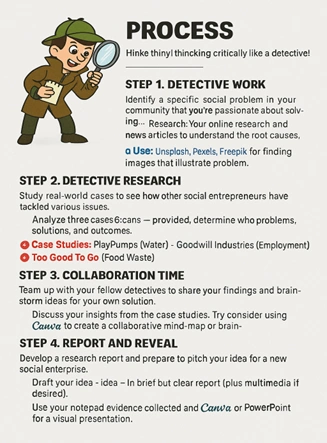 Follow the steps of a real Cause Hunter. Work in your team. Think critically. Stay curious. And let the clues lead you to the root cause.
STEP 1 – FORM YOUR DETECTIVE AGENCY
What to do?
Create a squad of 3–5 Cause Hunters. Each team member picks a role (you can rotate during the project):
- 🧭 Team Leader – keeps everything on track.
- 🧠 AI Researcher – uses ChatGPT, Perplexity, etc.
- 📚 Field Investigator – finds real-life data and case studies.
- 🎨 Creative Designer – builds visuals and storytelling.
- 🎤 Presenter – prepares and leads the final pitch.
Tip: Good detectives talk to each other often. Work as a team, help each other grow.
STEP 2 – SPOT THE PROBLEM
What to do?
Choose a real-world social problem that matters to your team. It could be something local (in your town) or global.
How to do it?
- Use Google Search, AI tools (like ChatGPT or Perplexity) to research current social issues.
- Check platforms like Openpolis, Our World in Data, The Guardian – Social Justice.
- Write down your chosen issue and describe it in a few sentences.
Use tools like Google Trends and Perplexity AI to explore emerging social issues, and platforms like MindMeister or Miro to visually map out ideas. ChatGPT can help you summarize articles and suggest root causes. Canva AI allows you to turn your findings into a powerful visual report.
Below are links to the tools you can use
Use AI tools like ChatGPT to explore and summarize articles. Example prompt:
“Summarize this article from The Guardian on youth unemployment and highlight the root causes
+ Use: Google Trends, ChatGPT, Perplexity AI, Miro, MindMeister
Guiding Question: What is the real problem we care about?
STEP 3 – UNMASK “THE CAUSE OF THE CAUSE”
What to do?
Investigate what’s really causing the problem. Find 2–3 real-world case studies and analyze how others approached similar challenges.
How to do it?
- Use AI tools like ChatGPT, Perplexity AI to explore and summarize articles, reports, or interviews. Analyze:
- What’s the root cause?
- Who is affected?
- What solution was applied?
- Was it successful?
Suggested Case Studies:
- 🌍 PlayPumps (Access to clean water)
- 👩🏭 Goodwill Industries (Employment & integration)
- 🥫 Too Good To Go (Food waste & awareness)
+ Use:
ChatGPT, Canva (infographics), PDF.ai, Pexels, Freepik, Unsplash
Tip: Compare causes and outcomes in a table or infographic.
STEP 4 – BRAINSTORM YOUR OWN SOLUTION
What to do?
Time to be creative! Based on what you discovered, design your own social entrepreneurial idea to solve the root cause.
How to do it?
- Use AI tools to brainstorm ideas for solutions (ask: “What could solve this?”).
- Build a first draft: name, target group, mission, AI potential, expected impact.
- Use Canva AI or Miro to start shaping the visual idea.
Guiding Questions:
- What values guide your solution?
- How can AI support or scale your idea?
- Would this really help your community?
STEP 5 – BUILD YOUR REPORT & PITCH
What to do?
Prepare your Visual Investigative Report and get ready to present.
How to do it?
- Use Canva, PowerPoint, or Genially to create a clean, visual story.
- Keep it short (6–8 mins), structured, and powerful.
- Make sure to include:
- Problem + Root Cause
- Your Entrepreneurial Solution
- Role of AI
- Impact + Why it matters
+ Use: Canva, Genially, Miro, Freepik (graphics), Unsplash (photos), ChatGPT (scripting)
Tip: Use strong visuals. Don’t just read slides — tell the story like a real pitch.
STEP 6 – FEEDBACK & REFLECT
What to do?
After your pitch, receive peer and teacher feedback. Reflect on:
- What did you learn?
- How did the team collaborate?
- Would your idea work in real life?
Write a short personal reflection (1 paragraph) in your detective journal or digital workspace.
